
Single Bets vs Accumulators: Understanding the Real Risk
One common misconception among new bettors is that combining several strong favourites creates a safer bet. Although adding selections increases the potential payout, it also reduces the likelihood that every prediction will be correct.
Understanding the difference between single bets and accumulators is essential for evaluating football betting risks.
What Is the Difference Between a Single Bet and an Accumulator?
A single bet involves one selection. For example, predicting that Arsenal will win a particular match.
An accumulator, also called an acca or parlay, combines multiple selections into one wager. Every selection must win for the accumulator to pay out.
If just one selection loses, the entire accumulator normally loses.
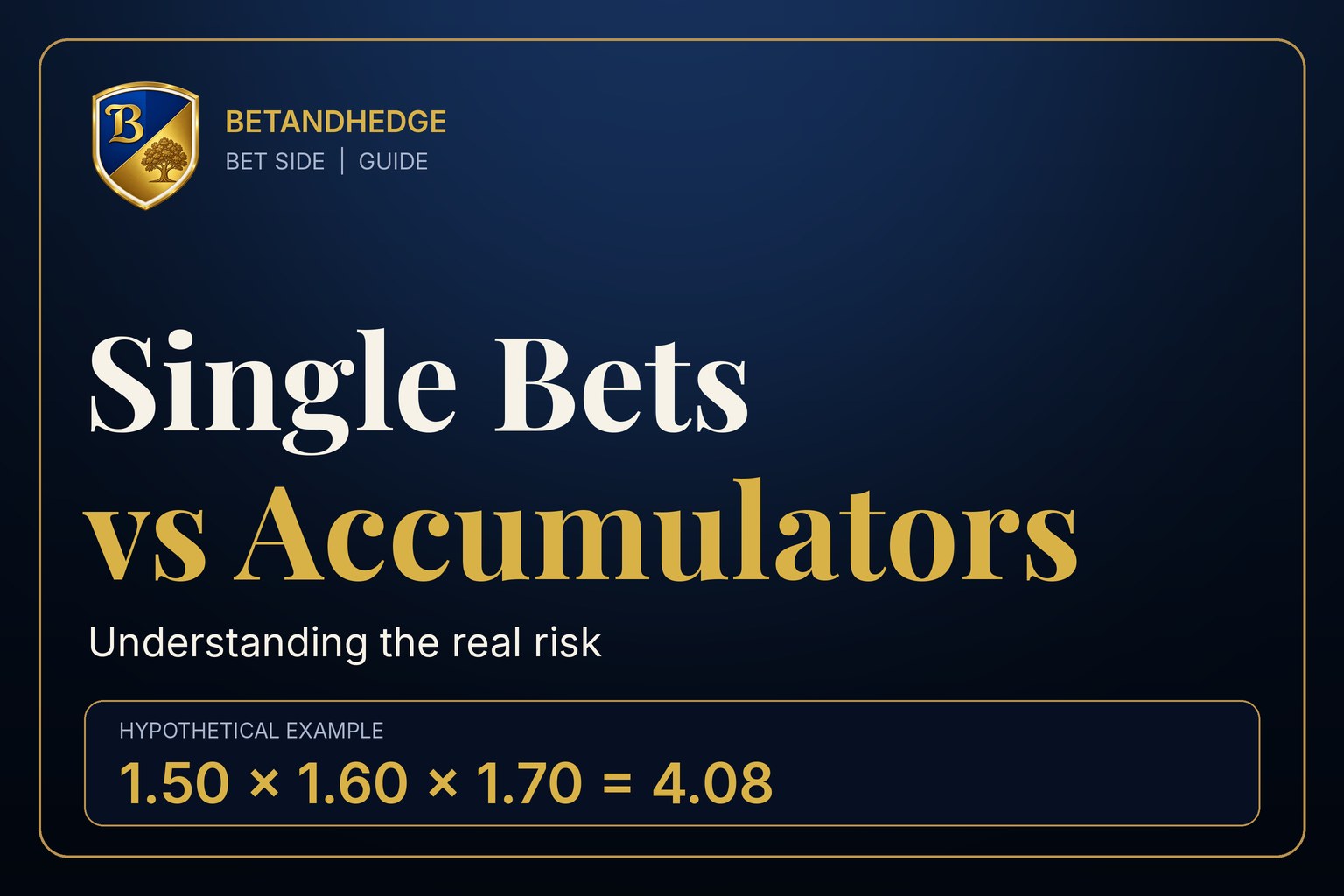
Consider this hypothetical example:
| Selection | Decimal Odds |
|---|---|
| Arsenal to win | 1.50 |
| Barcelona to win | 1.60 |
| Inter Milan to win | 1.70 |
Each selection might appear relatively likely when considered individually.
However, combining them means all three results must occur.
The combined decimal odds are:
A successful €10 accumulator would therefore return €40.80, including the original stake.
The higher potential return comes with a substantially lower probability of success.
Understanding Accumulator Probability
Decimal betting odds can be converted into implied probability using a simple formula:
For the example above:
| Selection | Odds | Implied Probability |
|---|---|---|
| Arsenal | 1.50 | 66.7% |
| Barcelona | 1.60 | 62.5% |
| Inter Milan | 1.70 | 58.8% |
Assuming the three outcomes are independent, their combined implied probability is:
This corresponds to the accumulator’s combined odds of 4.08.
In practical terms, the bookmaker prices this combination at an implied success probability of approximately one in four.
However, implied probability is not necessarily the true probability of an outcome. Bookmaker prices include margins, and actual probabilities may differ from those suggested by the odds.
Why Adding More Selections Increases Risk
Consider a five selection accumulator where every team is priced at decimal odds of 1.50.
Each individual selection has a bookmaker implied probability of approximately 66.7%.
Assuming independent outcomes, the combined implied probability is:
The combined odds would be:
This means the bookmaker’s combined price implies approximately a 13.2% chance of success and an 86.8% chance that at least one selection fails.
These figures describe the probabilities implied by the quoted odds, not verified real world win rates.
The important lesson is that adding more selections creates additional opportunities for the accumulator to fail.
Even when each individual outcome appears likely, the probability of every outcome occurring decreases as more independent selections are added.
The Hidden Effect of Bookmaker Margins
Bookmakers generally build a margin into their prices.
This means the odds offered to customers are usually less favourable than prices based solely on estimated fair probabilities.
Consider three hypothetical markets with bookmaker margins of approximately 4%, 5% and 4%.
These figures describe the margins in the individual markets, not a fixed fee deducted from each accumulator selection.
When selections are combined, the pricing disadvantage associated with each leg can compound.
The exact effect depends on the odds, the market structure and any correlation between selections.
This is why evaluating an accumulator requires more than simply multiplying attractive odds together.
A higher potential payout does not necessarily represent better value.
Single Bets and Accumulators: A Risk Comparison
| Feature | Single Bet | Accumulator |
|---|---|---|
| Number of selections | One | Two or more |
| Winning requirement | One correct selection | Every selection must win |
| Potential payout | Based on one set of odds | Combined odds may produce a larger payout |
| Probability of success | Depends on the individual selection | Generally decreases as independent selections are added |
| Bookmaker pricing | One market price | Multiple market prices combined |
| Main risk | The selected outcome does not occur | Any losing selection can cause the entire bet to lose |
Neither format guarantees a positive expected return.
The important distinction is how uncertainty and payout structure change when multiple selections are combined.
Why Do Most Football Accumulators Lose?
Accumulators with many selections are difficult to win because every leg must succeed.
For example, even if each of five independent selections had a genuine 70% probability of winning, the probability of all five winning would be:
That means approximately 83.2% of such accumulators would fail over many comparable trials.
This does not mean every accumulator is automatically a poor decision or that every single bet offers good value.
It means that the probability of success should be evaluated independently of the potential payout.
Bookmaker margins, incorrect probability estimates and correlated outcomes can further complicate the calculation.
Why Correlation Matters
Not every accumulator consists of independent events.
For example, combining a team’s victory with another outcome closely related to its performance can introduce correlation.
When selections are correlated, simply multiplying their individual probabilities may produce an inaccurate estimate.
This is especially relevant to accumulators involving multiple markets from the same football match.
Understanding whether selections depend on shared events or assumptions is an important part of evaluating betting risk.
A Useful Comparison With Financial Risk
Consider three separate financial decisions, each involving uncertainty.
If their outcomes were combined into a single arrangement where every decision had to succeed before any return was received, the resulting exposure would be different from holding three independent positions.
An accumulator creates a similar all or nothing condition.
The comparison is not exact because investments and betting markets have different structures, protections and expected returns.
Nevertheless, it illustrates an important principle: combining uncertain outcomes does not automatically create diversification.
In some cases, it concentrates risk.
Monitoring Betting Risk With BetAndHedge
Understanding probabilities is only one part of responsible decision making.
Looking at what betting spending adds up to over time can also help users evaluate their behaviour more objectively.
The BetAndHedge Reality Check tool shows what a betting budget could be worth over 10, 20 or 30 years if part of it were invested instead, using simplified assumptions based on the figures you enter.
The Hedge Score tool is a short questionnaire that gives an illustrative view of whether betting activity is building long-term wealth or consuming a bankroll, based on the figures you enter.
These tools are intended for education and risk awareness. They do not predict match results or guarantee improved betting performance.
Frequently Asked Questions
Is an accumulator riskier than a single bet?
An accumulator generally has a lower probability of success than its individual selections when all outcomes must occur. However, the comparison depends on the odds, probabilities and structure of the bets being evaluated.
What happens if one accumulator selection loses?
In a standard accumulator, one losing selection causes the entire bet to lose. Certain special products may have different settlement rules.
Are accumulators more profitable than single bets?
Not necessarily. Higher potential payouts do not guarantee higher expected returns. Profitability depends on the relationship between the odds offered and the actual probabilities of the outcomes.
How do you calculate accumulator odds?
For a standard accumulator using decimal odds, multiply the odds of each selection together.
For example:
Why do accumulators have such high odds?
Combined odds are higher because every selection must win. As more independent selections are added, the probability of the complete combination succeeding decreases.
Can several favourites form a safe accumulator?
No accumulator is guaranteed to succeed. Even when each selection has a relatively high probability, combining multiple uncertain outcomes reduces the probability that all of them occur.
Key Takeaway
A single football selection already involves uncertainty.
When multiple selections are combined into an accumulator, every additional leg creates another condition that must be satisfied.
Although the potential payout increases, the probability of winning generally decreases.
Understanding implied probability, bookmaker margins and the difference between potential returns and actual chances of success helps readers evaluate betting risks more realistically.
BetAndHedge encourages informed decisions, realistic expectations and responsible financial behaviour.